 2010 Ford GT90 Super Sport Car Concept
If Ford first introduced the GT90 Concept at the 2010 Detroit Auto Show next month, it would still be one of the most eyecatching cars on the show floor. What's amazing is that Ford unveiled the GT40 successor nearly 15 years ago. What's more, even by today's standards it's still a supercar among supercars.
The quad-turbocharged 6.0-litre V12 puts out an estimated 720 horsepower, the body is constructed completely of carbon fiber and top speed is somewhere in the 400 kph range. The only hints that it's not a modern supercar are the all-blue interior and wheels that look dated now.
So what's all the fuss about the GT90 Concept now? RM Auctions in the States has just announced that it will be offering the concept car at its upcoming Arizona sale. That's right, this is your chance to own one of the coolest concept vehicles of all time. This is the first time that the GT90 Concept has ever been publicly for sale at auction, and RM claims that it is in "excellent running condition, having been properly stored and maintained over the year." No estimated on price is given, but we're guessing it will take a large suitcase of cash to take the car home.
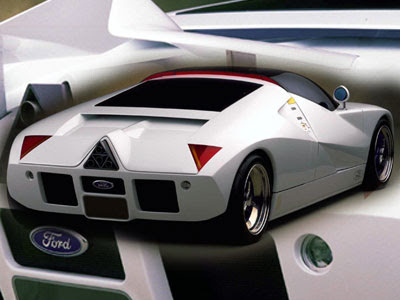 2010 Ford GT90 Super Sport Car Concept
The one-off GT90 Concept Car, labeled immediately as "the world's mightiest supercar" by Ford Motor Company on December 6, 1994, was the spiritual successor to the Ford GT40, the product of a colossal feud in the early 1960s between the Blue Oval from Dearborn and the Prancing Horse of Northern Italy. The GT90 draws from the design cues of its heritage and pays homage to the famed Le Mans-winning Ford GT40s of the 1960s, which were created after the failed attempt by Ford to buy out Ferrari.
At a development cost in the neighborhood of $3 million, the GT90 was certainly worthy of pulling styling cues from the original Ford GTs, and although it was never meant for production, it was built according to a Ford press release as a "test bed for technology, engineering and design concepts, and driver-oriented features that eventually may be used in Ford production vehicles."
Officially unveiled to the public in January 1995 at the Detroit Auto Show, the GT90 is finished in bright white with a bright blue and carbon fiber interior. It features a mid engine quad-turbocharged V12 that produces an estimated 720 horsepower and 660 pound-feet of torque. As a result, it had a claimed top speed of 253 mph, which even by today's standards would make it one of the fastest production cars in the world – faster even than a McLaren F1, which was widely considered the world's preeminent supercar at the time.
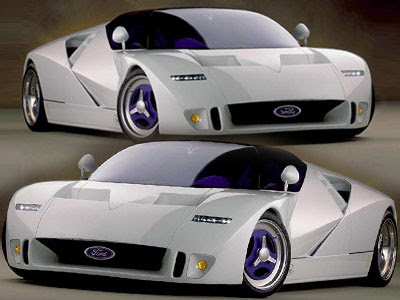 2010 Ford GT90 Super Sport Car Concept
The engine, which was a 48-valve six-liter V12, had to be combined together with four Garrett Systems T2 turbochargers in order to reach its estimated 720 horsepower and was based on the Ford Modular engine. Created by using parts of two Lincoln V8 engines, engineers removed the last pair of cylinders from the rear of one engine and the first pair of cylinders from the front of the other engine. The cut-down engines were then welded together with the final result being a 90-degree V12, which utilized a 90.2 mm bore and a 77.3 mm stroke to achieve maximum power.
The GT90 features the FFD-Ricardo five-speed manual gearbox found on the XJ220 and, considering the torque load that it is designed to handle, is noted as having a relatively light shift quality. Also borrowed from the XJ220 comes the all around double wishbone suspension that was designed to enable the car to handle well at top speeds.
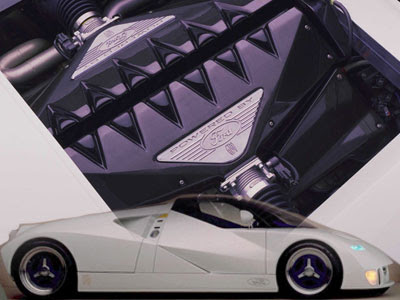 2010 Ford GT90 Super Sport Car Concept
Using Ford's new "Edge" design philosophy, the car incorporated advanced technology with a mixture of flat planes, angles, glass and triangular shapes that seemingly all collided together. The GT90 was the first car created using this new styling directive from Ford, which went on to be responsible for the creation of other Ford products like the Ka and Cougar. The effect is most impressive and a wonderfully executed stylistic throwback to its GT40 predecessor, which at once stays true to its heritage but acknowledges the advances in modern design. Taken directly from race car technology, the GT90 body panels are molded out of carbon fiber while the chassis is formed out of a honey-comb sectioned aluminum monocoque.
The GT90 is a test bed of advanced technology and design. It sports a tinted, laminated glass bubble over the cockpit and a spoiler that rises off the rear deck at high speeds. According to Ford, it has a "design that tightly enclosed its mechanicals with no wasted space; high tech lighting and blind-spot detection systems; and tiles like those on the space shuttle to shield the V12's exhaust outlets."
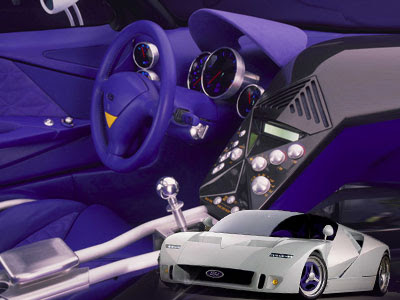 2010 Ford GT90 Super Sport Car Concept
After its unveiling in Detroit, the GT90 made its rounds on the Auto Show Circuit in 1995, traveling around the world to Frankfurt and as far away as Tokyo. With few other showings in between, the car recently was shipped over to Europe to be on display in the Ford of Europe 2008 exhibit at the Goodwood Festival of Speed. After returning home, the car was shipped to Alabama where it was on display as part of the Mustang 45th Anniversary Celebration.
This superb concept car remains in excellent running condition, having been properly stored and maintained over the years in between its show appearances. RM Auctions is proud to publicly offer the GT90 for the first time ever at auction. A remarkable one-off piece of automotive history and cutting-edge design, its offering may very well be a once in a lifetime opportunity for Ford devotees and concept car enthusiasts.


 Bertone returns to the Geneva Motor Show 2010, after a two year absence from the international scene, unveiling a concept car that makes its world premiere here: the Pandion, an aggressive yet beautiful coupé designed as a tribute to Alfa Romeos’ one hundred year anniversary. The Alfa Romeo Pandion Concept: an extreme and controversial sports car in typical Bertone fashion. The size of the concept car (4620 mm in length, 1971 mm wide, 1230 mm high, 2850 mm wheelbase) offers a compact sports car external dimensions with a large sports car interior feeling. Bertone Pandion Design Sketchoffers a compact sports car external dimensions with a large sports car interior feeling, all powered by a 4.7 litre, 450 CV 8-cylinder Alfa Romeo engine.
 The name comes from the animal world, as Pandion Haliaetus is the scientific name for an Osprey: a sea hawk that nests and lives in coastal areas. The designers, led by Mike Robinson, have drawn inspiration from the wings of this predator to invent the spectacular door opening mechanisms, and from the hawks' facial markings to project the traditional Alfa family feeling into the next era of design.
 The designers, led by Mike Robinson, have drawn inspiration from the wings of this predator to invent the spectacular door opening mechanisms, and from the hawks’ facial markings to project the traditional Alfa family feeling into the next era of design. In almost a century of Bertone tradition, it is not the first time that natural wonders have inspired the names of concept cars. Just think of the Corvair Testudo (1963) and, by no coincidence, the Alfa Romeo Canguro (1964), Carabo (1968) and Delfino (1983).
 According to this interpretation, the Pandion’s design is, like every Alfa Romeo, a perfect synthesis between ‘Skin and Frame’, an ideal balance resulting from a tension between opposites: technology and sensuality, rationality and instinct, architecture and sculpture, structuralism and organicism, industrial excellence and excellent craftsmanship.
 The Pandion’s taut and muscular body is the result of an original interpretation of the Alfa Romeo badge, where the man-eating snake depicted there represents the attraction of elegance (what we call the ‘Skin’), and the aristocratic cross symbolises the rigour of rational thought, the technological aspect (what we call the ‘Frame’).
 The design of the Pandion is based on a concept Robinson calls: "Skin & Frame” - a new interpretation of the inherent duality in the 100 year old Alfa Romeo logo. “Skin” refers to the snake in the logo, representing the world renowned Italian excellence in beautiful, seductive forms; and “Frame” refers to the cross in the logo, representing the mechanical excellence in high performance Italian race cars. The combination of the two has now become a dynamic dial searching for an ideal balance resulting from the tension between opposites: technology and sensuality, rational and emotional, architectural layout and sculptural form, structural and organic, industrial excellence and artisan excellence.
 According to this interpretation, the vibrant energy in every Alfa Romeo is represented by Pandions’ spinal structure (or ‘Frame’), which crosses the length of the car from the V-shaped grille in the nose of the car to the V-shaped bumper in the tail of the car, crossing the interior as a visually aesthetic structural element which supports the surrounding shell (or ‘Skin’).
 The Alfa Romeo Pandion Concept has the profile of a true sports car, with no room for compromise. The architectural layout is 'cab rearward', meaning the passenger compartment is positioned towards the rear of the car and the long bonnet pushes the car's visual centre rearward. The body side visually connects the sensuous front end with the razor-edged rear by means of an extremely long flowing side window which stretches from front wheel arch to rear, enhancing the excellent accessibility of this low-bodied sports coupé.
 Since sports cars are traditionally difficult to get in and out of, this important ergonomic activity has been facilitated with an extra wide door opening to make up for the low roofline. This new graphic formula not only adds a striking new visual division between the upper and lower parts of the body, but it also offers an incredible panorama window for passengers inside. The strong diagonal dark-light division in the rear of the side view accentuates the powerful rear wheel drive layout and draws special attention to the hidden door opening mechanism


 Toyota FT-HS wallpaper
 Toyota FT-HS front exterior display
 Toyota FT-HS back exterior view
 Toyota FT-HS rear top view
 Toyota FT-HS dashboard pictures


